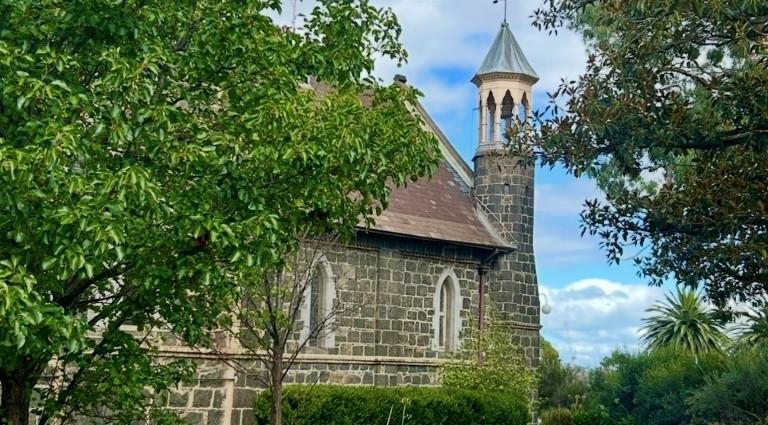
Built to last–as it has for almost 200 years–the bluestone church demonstrates building techniques of a by-gone age. At the base of the wall, long bluestone blocks rest on a shallow earth foundation. Above that, bluestone blocks are set in lime mortar. And timber is held together with cut nails. The roof is of slate which has a long life, although it is expensive to replace once it reaches its end of life.
And that is the point. The old building techniques were manually intensive, so they are expensive today, but we seek to keep the building authentic. Only a few people know the old skills. We can only carry out the restoration in stages, and we ask you, if you can, to contribute to the cost of this work.
There are other–not quite so old–buildings on site. “Wood Hall” is a brick building, built around 1890. Founded on two rows of staggered blocks of bluestone resting on another shallow earth foundation, the damp proof course is a layer of thin slates. The bricks, being so old, are soft, because they were only burnt to a low temperature. The soft bricks were set in a soft lime mortar in which shell grit was a significant component. Over time this lime mortar has eroded in several places. It needs to be repointed with fresh lime mortar. A cement mortar would be too hard: any movement in the wall–and there always are such movements–would cause the bricks to break against the hard cement mortar. Only a few bricklayers have experience in repointing, using pure lime mortar.
Donations made to the Christ Church Hawthorn Restoration Appeal through the National Trust of Australia (Victoria) are allowable as deductions for tax purposes.
Yes
Yes, as soon as your donation is processed.
We acknowledge the Traditional Owners of Country throughout Victoria and recognise their continuing connection to lands, waters and communities. We pay our respects to Aboriginal and Torres Strait Islander cultures; and to Elders past, present and future.
Built to last–as it has for almost 200 years–the bluestone church demonstrates building techniques of a by-gone age. At the base of the wall, long bluestone blocks rest on a shallow earth foundation. Above that, bluestone blocks are set in lime mortar. And timber is held together with cut nails. The roof is of slate which has a long life, although it is expensive to replace once it reaches its end of life.
And that is the point. The old building techniques were manually intensive, so they are expensive today, but we seek to keep the building authentic. Only a few people know the old skills. We can only carry out the restoration in stages, and we ask you, if you can, to contribute to the cost of this work.
There are other–not quite so old–buildings on site. “Wood Hall” is a brick building, built around 1890. Founded on two rows of staggered blocks of bluestone resting on another shallow earth foundation, the damp proof course is a layer of thin slates. The bricks, being so old, are soft, because they were only burnt to a low temperature. The soft bricks were set in a soft lime mortar in which shell grit was a significant component. Over time this lime mortar has eroded in several places. It needs to be repointed with fresh lime mortar. A cement mortar would be too hard: any movement in the wall–and there always are such movements–would cause the bricks to break against the hard cement mortar. Only a few bricklayers have experience in repointing, using pure lime mortar.
Donations made to the Christ Church Hawthorn Restoration Appeal through the National Trust of Australia (Victoria) are allowable as deductions for tax purposes.
Yes
Yes, as soon as your donation is processed.
We acknowledge the Traditional Owners of Country throughout Victoria and recognise their continuing connection to lands, waters and communities. We pay our respects to Aboriginal and Torres Strait Islander cultures; and to Elders past, present and future.