Katrina's story
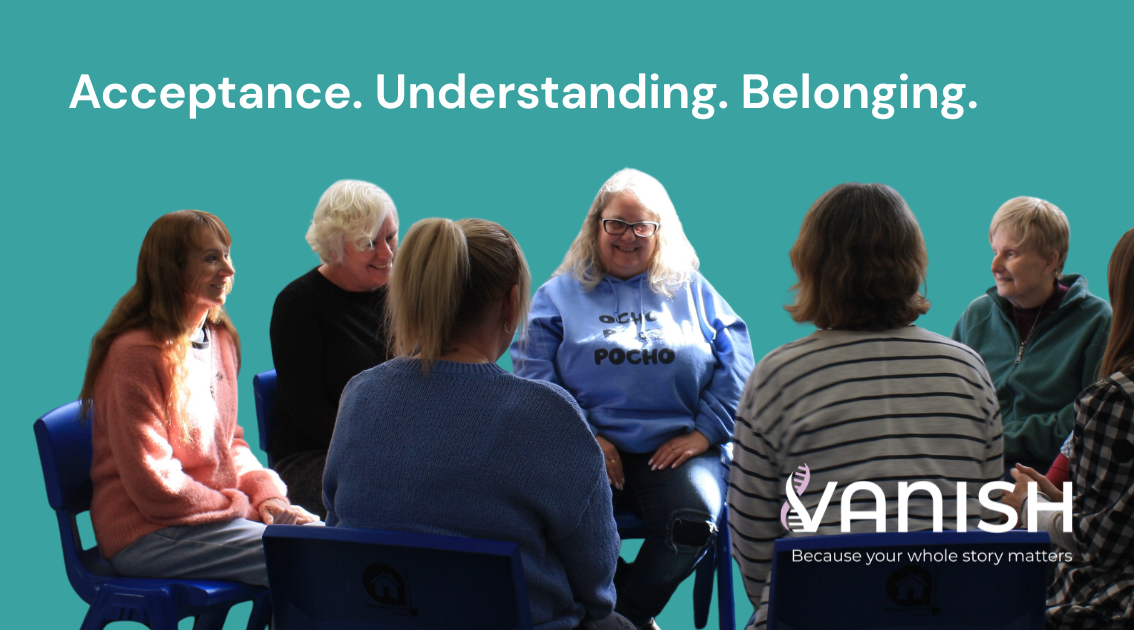
Katrina is an adopted person who has been attending VANISH's Melbourne peer support group for eight years. Before she found the group, she tried two different counsellors when she was struggling with her reunion with her mother, but neither had the understanding she needed. As she put it, "You can't counsel me on something that you just don't understand."
Only through the group did things start to make sense. Hearing from others who had lived through similar experiences gave Katrina a framework for understanding her own story. Eight years on, she still attends every month.
"There's no doubt that VANISH provides essential support and understanding for adoptees," she says. "Because I haven't found it anywhere else."
Katrina's experience is echoed across our four support groups, in Melbourne, Ballarat, Albury-Wodonga and online. One long-time member of our Albury-Wodonga group told us what keeps her coming back: "It's good to have someone to talk to that understands. It's really good to hear other people's stories and support each other." For this regional attendee, it's also one of her only regular opportunities to get out and connect with others. Her hope is simple: "I just hope it keeps on continuing."
Some difficult news
Earlier this month, VANISH was advised that Victorian Government funding for our support groups, along with our counselling brokerage program, will end on 30 June 2026. This isn't a reflection of the value or effectiveness of these services – in fact, demand has grown over the past two years. Unfortunately we're not the only grassroots organisation in this situation, as the government tightens its belt across community services.
This leaves us with modest funding for our information and family tracing services, but no funding to help adoptees navigate the ongoing emotional and psychological impacts of adoption.
Adoption and mental health
Most people are unaware that many adoptees and mothers of loss experience significant mental health challenges, including depression, anxiety, and suicidality. Recent research undertaken by the University of Melbourne with the VANISH community found that 58.2% of adoptees and 60% of mothers separated from children through adoption experience high or very high levels of psychological distress – around four times the rate observed in the general Australian population.
Yet most health professionals don't understand the depth or duration of these impacts, and specialist services remain underfunded and hard to find.
The power of peer support
Peer support is not simply a social activity. It is a specialised and highly effective intervention that provides connection, understanding, hope, and a sense of belonging. It often serves as an early intervention that prevents isolation from escalating into more acute mental health difficulties. This is backed up by national research, including the Australian Institute of Family Studies' study on the impacts of adoption (2012), which identified peer support as one of the most effective responses available to people affected by adoption.
Our request
This EOFY, we're asking for interim support to help us keep running our support groups over the next 3-6 months while we actively pursue alternative funding.
No matter how big or small, your gift will make a difference.
All donations over $2 are tax deductible and you can estimate the 2025-26 tax refund on your donation with this calculator.
Thank you for considering a gift to VANISH, to help make sure people like Katrina, and everyone else who relies on these groups each month, continue to have somewhere to turn. 💙
Yes
Yes, as soon as your donation is processed.
VANISH acknowledges the Boon Wurrung and Woi Wurrung people of the Kulin Nation as the Traditional Custodians of the lands where we live and work. Sovereignty was never ceded. We pay our respects to Elders past and present.
Katrina's story
Katrina is an adopted person who has been attending VANISH's Melbourne peer support group for eight years. Before she found the group, she tried two different counsellors when she was struggling with her reunion with her mother, but neither had the understanding she needed. As she put it, "You can't counsel me on something that you just don't understand."
Only through the group did things start to make sense. Hearing from others who had lived through similar experiences gave Katrina a framework for understanding her own story. Eight years on, she still attends every month.
"There's no doubt that VANISH provides essential support and understanding for adoptees," she says. "Because I haven't found it anywhere else."
Katrina's experience is echoed across our four support groups, in Melbourne, Ballarat, Albury-Wodonga and online. One long-time member of our Albury-Wodonga group told us what keeps her coming back: "It's good to have someone to talk to that understands. It's really good to hear other people's stories and support each other." For this regional attendee, it's also one of her only regular opportunities to get out and connect with others. Her hope is simple: "I just hope it keeps on continuing."
Some difficult news
Earlier this month, VANISH was advised that Victorian Government funding for our support groups, along with our counselling brokerage program, will end on 30 June 2026. This isn't a reflection of the value or effectiveness of these services – in fact, demand has grown over the past two years. Unfortunately we're not the only grassroots organisation in this situation, as the government tightens its belt across community services.
This leaves us with modest funding for our information and family tracing services, but no funding to help adoptees navigate the ongoing emotional and psychological impacts of adoption.
Adoption and mental health
Most people are unaware that many adoptees and mothers of loss experience significant mental health challenges, including depression, anxiety, and suicidality. Recent research undertaken by the University of Melbourne with the VANISH community found that 58.2% of adoptees and 60% of mothers separated from children through adoption experience high or very high levels of psychological distress – around four times the rate observed in the general Australian population.
Yet most health professionals don't understand the depth or duration of these impacts, and specialist services remain underfunded and hard to find.
The power of peer support
Peer support is not simply a social activity. It is a specialised and highly effective intervention that provides connection, understanding, hope, and a sense of belonging. It often serves as an early intervention that prevents isolation from escalating into more acute mental health difficulties. This is backed up by national research, including the Australian Institute of Family Studies' study on the impacts of adoption (2012), which identified peer support as one of the most effective responses available to people affected by adoption.
Our request
This EOFY, we're asking for interim support to help us keep running our support groups over the next 3-6 months while we actively pursue alternative funding.
No matter how big or small, your gift will make a difference.
All donations over $2 are tax deductible and you can estimate the 2025-26 tax refund on your donation with this calculator.
Thank you for considering a gift to VANISH, to help make sure people like Katrina, and everyone else who relies on these groups each month, continue to have somewhere to turn. 💙
Yes
Yes, as soon as your donation is processed.
VANISH acknowledges the Boon Wurrung and Woi Wurrung people of the Kulin Nation as the Traditional Custodians of the lands where we live and work. Sovereignty was never ceded. We pay our respects to Elders past and present.